- Use it to time participation in games.
- To help children calm down by taking 'time out' when upset.
- To develop the awareness of the length of five minutes.
- To motivate as the student engages in 'beat the clock 'activities.
- Classroom management- setting a target time for pupils to enter class and settled down.
- Use to time an oral presentation.
- Use in timed tests.
- Use in teaching analogue clock- how minutes work
-
 Sand timers provide a visual representation of a period of time and children respond incredibly well when they’re used in a variety of contexts. Activities in school and at home-
 -
 This is a durable table square which folds in order for pupils to easily identify the answer to any multiplication sum using the numbers 1 - 10.
 -
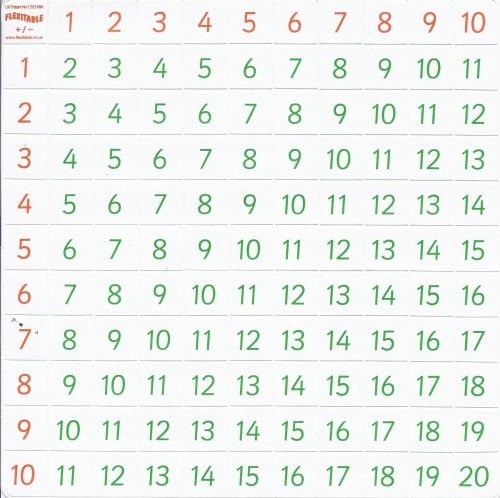
 This is a durable tool for the addition of two numbers up to twenty. The answer is found by folding the square. It would support and, over time, familiarise a weak student, of these key facts.
 -
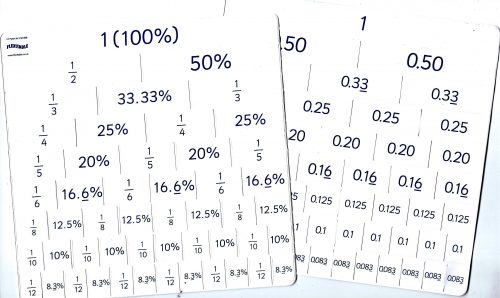
 This fdouble-sided flexitable grid folds to find equivalent fraction, percentage and decimal values.
 -
 This plastic grid of numbers 1-100, features numbers written in alternate colours blue and green. This helps identify odd and even numbers.
 -
 is is a new addition to the Flexitable range which supports pupils in calculations requiring the 12 times table.
 -
Sale!
 This set includes 8 transparent 3-D shapes and 8 compementary folding shapes. The shapes are - cube, cone, cylinder, retangular prism, triangular prism, hexagonal prism, square pyramid and triangular pyramid.
 -
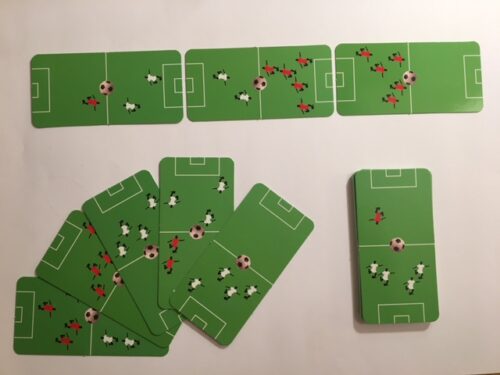
 Games are a fun way of practising skills. This set of thirty laminated domino cards featuring footballers aims to improve immediate number quantity recogntion without reliance on one model of number pattern as on a dice or domino. Number is an abstract idea - it doesn’t have a colour or shape though many teaching tools would have children believe this. Children learn to count by rote, repetitiously saying the numbers one to ten. Yet, we are born with a number template for quantities up to 4 which should make it easy to identify which is the greater quantity in up to 5 items. In the creation of the decimal number system, the recognition of number quantity up to 5 without needing to count is useful. Ten can then be visualised as two fives, six is one five and one more, nine is two fives less one etc. Continual playing of this game should reduce reliance on one by one counting and encourage more efficient recognition of quantities. Five will always be five whether the footballers are positioned closely together or far apart, and whether they are in a line or in a cluster.
 -
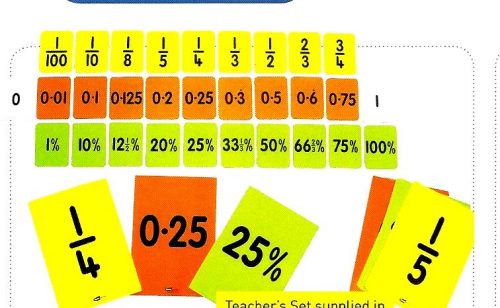
 This is a colourful and clear visual comparison of fractions. It is laminated for durability
 -
 This resource is designed to support the teaching of order and equivalence of quantities relating to parts of a whole. The resource is flexible and can be used for reference or cut up and used in a matching activity. Why not order two and make it into a game?
 -
 Each set contains 30 cards and is designed to support the teaching of 'ordering' and equivalence'.
 -
 This 8 sided transparent (gem) dice features the numbers 1 - 8
 -
 This geoboard 5 x 5 and help pupils explore concepts such as area, perimeter, shape, and symmetry.
 -
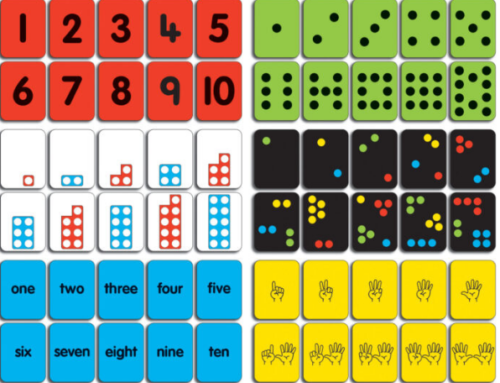
 This set of 60 cards, 7.5 x 6.5 cm comprehensively represents different models of representing the numbers 1 - 10. Games and matching and ordering activities using these cards, will broaden children's appreciation of number quantity and the connections between the different representations. Recognising quantities without needing to count one by one, is an important mathematical ability.
 -
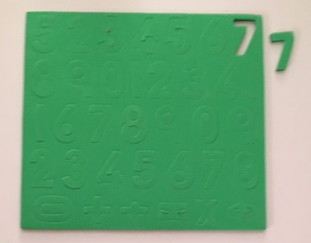
 This pack contains 3 sets of the foam magnetic numbers 0-9 plus one set of function symbols including = < and >.
 -
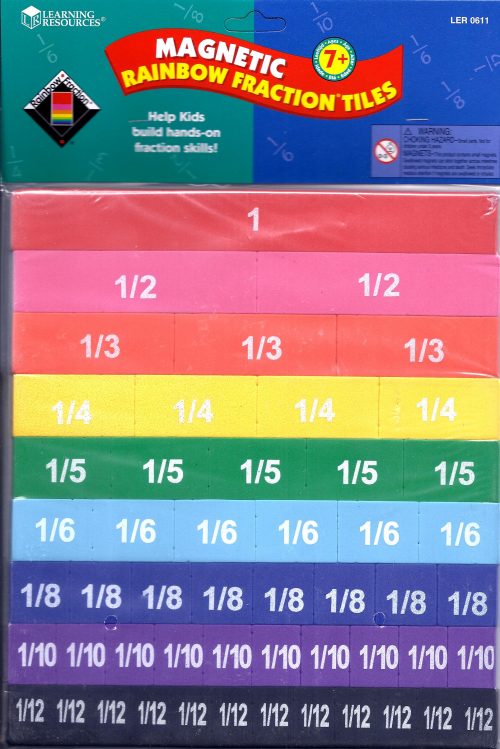
 This multisensory tool makes teaching fractions easier by permitting students to physically manipulate the tiles and demonstrates the visual concept of fractions. A small enclosed booklet gives ideas for its use.